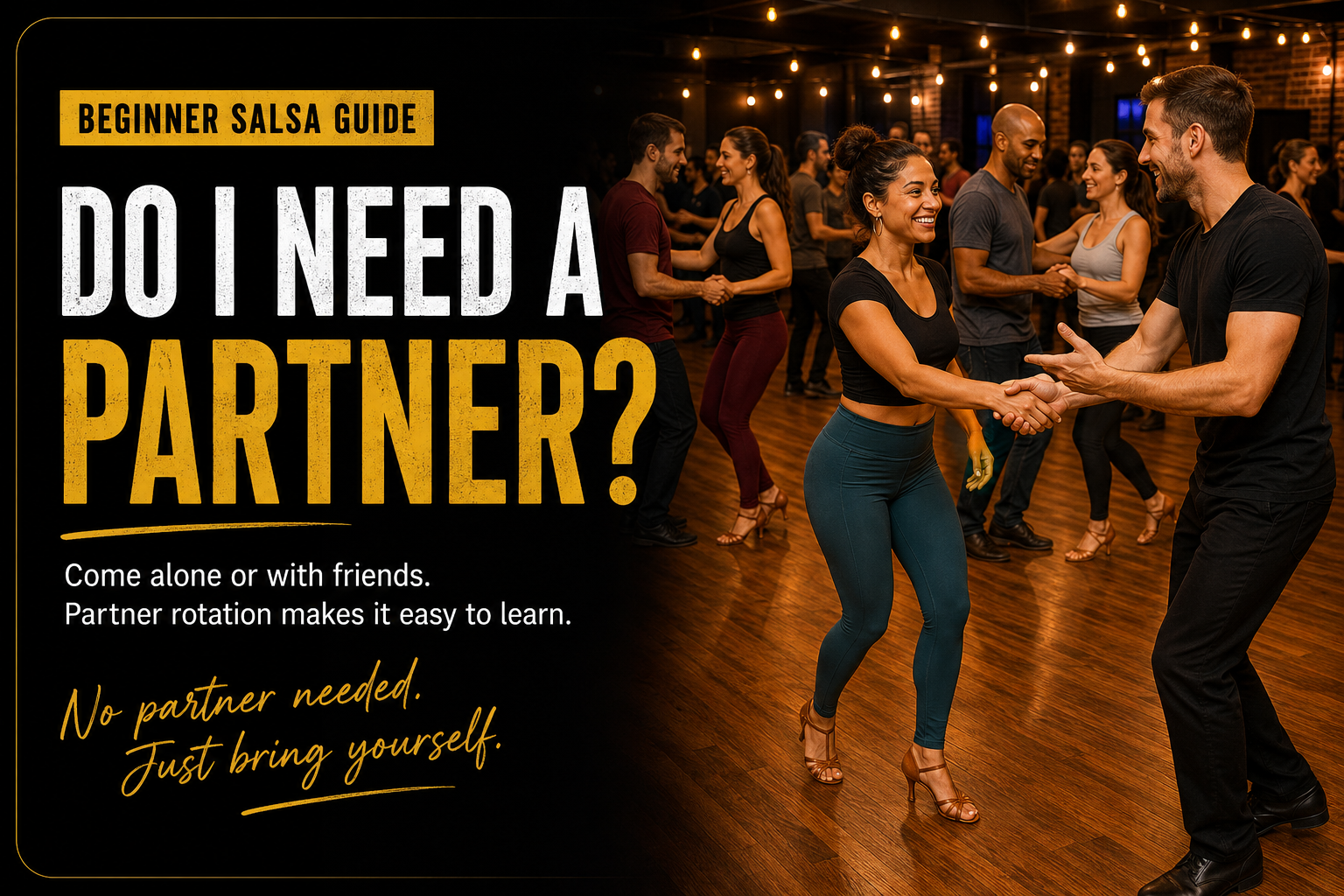
Do You Need a Partner for Salsa Classes?
No—you do not need to bring a partner to join a salsa class.
Many people attend salsa classes alone, particularly when they are learning for the first time. Salsa classes commonly use partner rotation, which means you dance with several people during the lesson instead of remaining with one partner throughout.
At Inspire Mambo, complete beginners are welcome to attend by themselves, with a friend or as a couple. You do not need previous dance experience, and you will not be expected to arrive already knowing somebody.
If attending alone is one of the things making you hesitant about trying salsa, this guide explains exactly what to expect.
Can I really attend a salsa class alone?
Absolutely.
People arrive at salsa classes for many different reasons. Some come with a partner, while others want to:
- Learn a new skill
- Meet people locally
- Become more confident
- Find an enjoyable way to exercise
- Prepare for a holiday or special event
- Join the salsa social-dancing community
- Try something different after work
- Return to dancing after time away
You will probably not be the only person attending alone. Even students who arrive with friends often rotate and dance with the rest of the class once partnerwork begins.
A friendly salsa class should be structured so that attending alone feels completely normal rather than unusual.
How does partner rotation work in salsa classes?
During the partnerwork section of a salsa lesson, the teacher will usually organise students into pairs.
You practise a movement for a short period before the teacher asks one group—often the leaders or followers—to move to the next person. This creates new pairs around the room.
A typical sequence might look like this:
- The teacher demonstrates a movement.
- The class practises it without a partner where appropriate.
- Students form pairs.
- Each pair practises the movement together.
- The teacher calls for a partner change.
- One line or circle moves to the next person.
- The class repeats the same movement with a new partner.
You may rotate several times while learning one piece of partnerwork.
Nobody is being selected or rejected during this process. The teacher manages the rotation, and everybody changes at the same time.
Why do salsa classes rotate partners?
Partner rotation is not simply a way of accommodating people who attend alone. It can also improve your dancing.
Every dancer moves and responds slightly differently. If you only practise with one person, you can unintentionally memorise that person’s habits rather than learning to communicate the movement clearly.
Rotating partners helps you understand whether you are genuinely leading or following the movement.
Leaders learn to communicate more clearly
A leader cannot assume that every follower will automatically know what is coming next. Dancing with different people encourages leaders to use appropriate timing, positioning and connection rather than force or anticipation.
Followers learn to respond rather than memorise
A follower who repeats a sequence with only one partner may begin anticipating the next movement. Rotation encourages followers to respond to the information they actually receive.
Both partners become more adaptable
People differ in height, stride length, experience, confidence and movement style. Dancing with several partners helps students become more comfortable making natural adjustments.
The class becomes more social
Rotation gives everybody a simple reason to say hello. It helps prevent isolated groups from forming and makes it easier for newcomers to become part of the class.
You do not need to make extended conversation during each rotation. A smile, introduction and “thank you” are more than enough.
What if there are unequal numbers of leaders and followers?
Salsa classes do not always have perfectly equal numbers.
There may occasionally be more leaders than followers or more followers than leaders. A well-managed class can accommodate this.
The teacher might:
- Join the rotation
- Ask an assistant teacher to participate
- Create a rotating rest position
- Arrange a small group of three
- Encourage students who are comfortable doing so to practise another role
- Spend additional time on individual footwork while pairs rotate
Having one more person in a particular role does not ruin a class. It simply means somebody may practise independently for one rotation before rejoining with the next partner.
That short break can also be useful for reviewing the movement, watching the demonstration or asking the teacher a question.
What are leaders and followers?
In partner salsa, the leader initiates and guides the movement, while the follower interprets and responds to that guidance.
These roles are about the structure of the dance—not about somebody controlling the other person.
Traditionally, men have often learned the leading role and women the following role, but this is not a requirement. People can choose the role they are most interested in learning, and some dancers eventually learn both.
If you are uncertain which role to choose, ask the teacher before the class. For most complete beginners, it is helpful to concentrate on one role initially while becoming comfortable with the timing and basic movements.
Can couples remain together during the lesson?
If you attend with a partner, you can usually ask to remain together, although the precise arrangement depends on the class.
Some couples prefer not to rotate because:
- They are learning for a wedding
- One person feels particularly nervous
- They want to practise specifically with each other
- There is a personal or accessibility reason
- They are not yet comfortable changing partners
That is understandable.
However, if you are both comfortable rotating, it can improve your learning. You will practise with each other again, but you will also discover whether your leading and following work with other dancers.
Couples sometimes develop compensating habits without realising it. Rotation can help reveal those habits in a supportive environment.
Speak to the teacher before the lesson if you would strongly prefer to remain together.
What if I feel nervous dancing with strangers?
Feeling nervous before your first partner-dance class is extremely common.
You may be thinking:
- What if I make a mistake?
- What if I forget the steps?
- What if the other person is more experienced?
- What if I feel awkward?
- What if nobody wants to dance with me?
A properly structured beginner class is designed for people who do not already know what they are doing. Making mistakes is not an interruption to the lesson—it is part of the lesson.
Everyone changes partners together, so you do not have to approach strangers and ask them to dance during the class. The rotation creates the interaction for you.
You are also not expected to perform. You are practising a small movement with another learner for a short period before changing partners.
The first few rotations may feel unfamiliar, but they usually become much more natural once the class is moving.
What if I make a mistake with a partner?
You will make mistakes, and so will everybody else.
You might:
- Step on the wrong count
- Turn in the wrong direction
- Forget what comes next
- Lose the timing
- Begin leading too early
- Anticipate a movement
- Temporarily forget which foot you should be using
None of this means you are bad at dancing.
If something goes wrong, simply stop, smile and begin again from the basic step. You do not need to apologise repeatedly or explain yourself.
Good class etiquette is cooperative rather than critical. Students should not blame each other, force movements or attempt to teach their partner something different from what the instructor has demonstrated.
If a movement consistently feels uncomfortable or confusing, ask the teacher for help.
Do I have to touch people during a salsa class?
Salsa partnerwork involves physical connection, usually through the hands, arms, shoulders or an appropriate dance hold.
The connection should remain respectful and relevant to the movement being taught. You always have the right to establish personal boundaries.
You can:
- Tell a partner if a hold feels uncomfortable
- Ask the teacher to clarify the correct hand position
- Sit out a rotation
- Decline to dance with somebody
- Stop immediately if something hurts
- Speak privately to the teacher about a concern
A welcoming class should take safety, consent and respectful behaviour seriously.
Inspire Mambo’s aim is to create an environment where people can learn without feeling pressured or uncomfortable.
Can I come with a friend who is not my dance partner?
Yes. Bringing a friend can make the first evening feel less intimidating.
You can arrive together, take part in the warm-up and practise alongside each other. Once rotation begins, you will probably meet other people in the class as well.
Your friend does not need to be the opposite sex, choose a different role or have any dance experience. You can both register as leaders, both register as followers or choose different roles.
The important point is that neither of you needs to provide a permanent partner for the other.
What happens before partnerwork begins?
A beginner salsa lesson will not normally place you immediately into complicated partnerwork.
The class may begin with:
- Understanding the salsa rhythm
- Learning the basic step
- Practising weight changes
- Simple footwork
- A basic turn
- Posture and positioning
- Following the teacher without a partner
This gives you time to become comfortable with the music and movement before working with somebody else.
At Inspire Mambo, beginner material is taught gradually. The objective is not to overwhelm you with a long routine. It is to help you understand manageable building blocks that can be practised successfully.
For more practical preparation, read our guide to what to wear, bring and expect at your first salsa lesson.
Do you need a partner for salsa social dancing?
You also do not necessarily need a permanent partner for salsa social dancing.
At a salsa social, people usually ask different dancers to join them for individual songs. You may attend with friends but dance with several people during the evening.
Social dancing is less structured than a class because the teacher does not organise rotations. However, beginner classes help you become familiar with dancing with different people before attending a larger social event.
You never have to accept every invitation, and you can politely decline a dance without providing an explanation.
Is attending alone a good way to meet people?
It can be.
Salsa naturally creates repeated, low-pressure interaction. You meet partners during rotations, recognise returning students and gradually become familiar with the wider class.
This can be easier than entering an unstructured social event where you are expected to introduce yourself without a shared activity.
However, you do not have to be highly outgoing. You can concentrate on learning and allow the social side to develop naturally over several weeks.
Consistency matters. Returning to the same weekly class gives people an opportunity to recognise you and creates a stronger sense of community.
Frequently asked questions
Will I be paired with another complete beginner?
Often, yes. Beginner classes contain people at different points in their early learning, but everybody is working on the material being taught.
You may also rotate to somebody with slightly more experience. This is normally helpful, provided both people remain patient and follow the teacher’s instructions.
Will everyone have to watch me dance?
No. The class learns together. People are usually concentrating on their own feet, timing and partnerwork—not analysing you.
Can I attend if I am shy?
Yes. You do not need an outgoing personality to learn salsa. Partner rotation provides a structured form of interaction, and conversation can remain as simple as exchanging names and saying thank you.
What happens if I do not want to rotate?
Speak to the teacher before the class. You may be able to remain with your partner or sit out selected rotations. The teacher can explain the available options.
Do I need to know whether I am a leader or follower before registering?
It is useful to select a role when registering, but you can contact the teacher if you are uncertain. The roles will also be explained during the lesson.
Do I need previous dancing experience?
No. Complete beginner classes are intended for people with little or no previous salsa experience.
Join a beginner salsa class in Sutton
You do not need to wait until you find somebody willing to attend with you.
Inspire Mambo runs friendly beginner salsa classes in Sutton for people who want to learn step by step in a welcoming environment.
You can attend alone, with friends or as a couple. Complete beginners are welcome, and no previous dance experience is required.
Register for a class and take your first step into salsa.
Beginner salsa guides
Prepare for your first class
You can attend salsa classes alone. Find out what your first lesson will involve, how quickly you can progress and when to try social dancing.
Getting started What to wear, bring and expect at your first class → Your progress How long does it take to learn salsa? → Social dancing What should you expect at your first salsa social? →