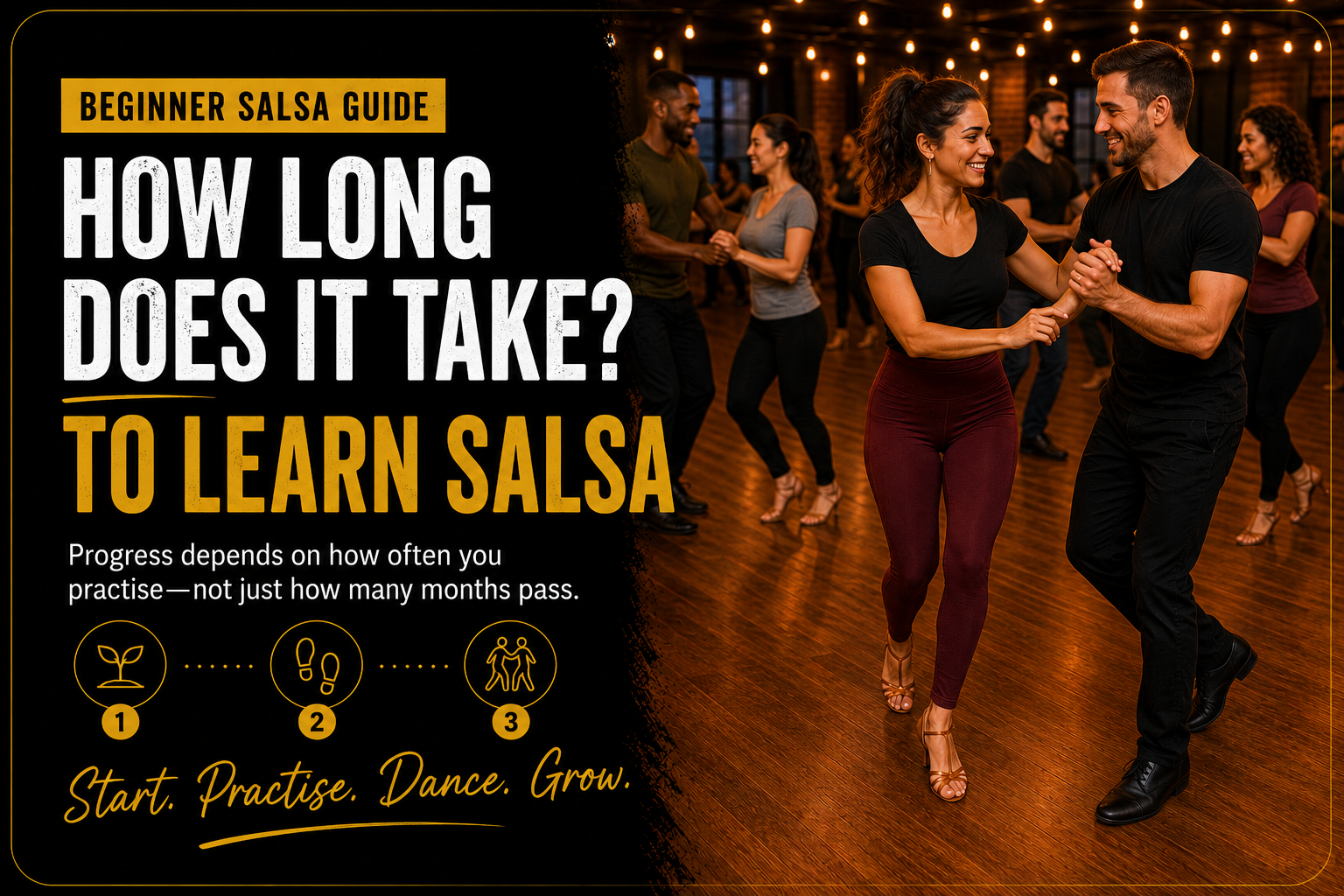
How Long Does It Take to Learn Salsa?
If you are considering your first salsa class, you may be wondering how long it will take before you can dance confidently.
Will you be dancing after one lesson? Does it take several months? Or do you need years of training before you feel comfortable at a salsa social?
The honest answer is that there is no single timetable for learning salsa.
In fact, asking how long it takes to learn salsa is not entirely a fair question. Progress depends on what you mean by “learn,” how regularly you attend classes, how much you practise and what level you would ultimately like to reach.
The encouraging news is that you do not need to master salsa before you can enjoy it. Most beginners can learn their first basic steps during a single class, dance a short sequence within a few weeks and begin feeling much more comfortable after a few months of consistent practice.
The short answer
A complete beginner may broadly expect to:
- Learn the basic salsa step and timing during the first few lessons.
- Dance several beginner combinations after four to eight weeks.
- Start attending beginner-friendly social dances within one to three months.
- Feel reasonably comfortable dancing socially after three to six months of regular classes and practice.
- Develop greater confidence, musicality and adaptability over six to twelve months.
- Continue refining their dancing for many years.
These are only general estimates—not deadlines.
Someone attending one class a week without practising may progress differently from someone attending twice a week, practising at home and regularly going to social dances.
Your previous experience also matters. A person who has studied another dance, played an instrument or participated in rhythm-based sports may initially find some parts easier. However, previous experience is not required.
What does “learning salsa” actually mean?
Different people mean very different things when they ask how long salsa takes to learn.
You might simply want to:
- Follow the music and complete the basic step.
- Learn a few turns and partnerwork combinations.
- Attend a salsa social without feeling overwhelmed.
- Lead or follow different partners comfortably.
- Dance with musicality and personal expression.
- Perform, compete or eventually teach.
These are separate milestones.
You can learn enough salsa to enjoy a beginner class relatively quickly. Becoming an adaptable and expressive social dancer takes longer because it involves more than remembering steps.
Social dancing combines:
- Timing
- Footwork
- Balance
- Partner connection
- Leading or following
- Spatial awareness
- Musical interpretation
- Confidence
- Communication
- The ability to recover from mistakes
These skills develop together gradually.
What can you expect from your first salsa class?
During your first class, you will usually begin with the fundamental salsa rhythm and basic step.
Depending on the class, you may also learn:
- How to transfer your weight correctly.
- A simple left or right turn.
- Basic partner positioning.
- How leading and following work.
- A straightforward partnerwork sequence.
- How to count the music.
You are unlikely to remember everything immediately, and you are not expected to.
A successful first lesson does not mean performing every movement perfectly. It means beginning to understand the rhythm, trying the movements and becoming more familiar with how salsa feels.
By the end of the class, you may be able to dance a basic sequence with a partner—even if you occasionally lose the timing or forget what comes next.
That is completely normal.
Your first four weeks
During your first month, salsa may feel unfamiliar. Your brain is processing the music, your feet are learning new patterns and you may be trying to coordinate your arms at the same time.
Some movements may feel natural, while others initially feel awkward.
With regular attendance, you may begin learning:
- The basic salsa step.
- Left and right turns.
- Simple changes of direction.
- Cross-body lead movements.
- Basic partner connection.
- A small selection of beginner combinations.
- How to restart if you lose the timing.
The most important development during these early weeks is not the number of moves you know. It is becoming comfortable with the fundamental rhythm and weight changes.
A dancer with a reliable basic step can build on it. Someone who rushes through dozens of combinations without understanding the foundations may struggle later.
Progress after one to three months
After one to three months of weekly classes, many beginners begin to feel more settled.
You may notice that:
- The basic step requires less conscious thought.
- You recognise familiar counts in the music.
- Turns feel less disorientating.
- You remember combinations more easily.
- Partner rotation becomes less intimidating.
- You recover from mistakes more quickly.
- You can dance through an entire song using a small number of movements.
This may also be the point at which you consider attending your first salsa social.
You do not need to wait until you feel completely confident. Social dancing is one of the ways confidence develops.
Your first social may still feel challenging. The music does not stop while an instructor explains the next movement, and every partner feels slightly different. However, you can have an enjoyable dance using only the basic step, a cross-body lead and a couple of simple turns.
Progress after three to six months
With consistent classes and some social practice, three to six months is often when beginners start feeling noticeably more comfortable.
You may be able to:
- Maintain your timing through most of a song.
- Lead or follow several familiar movements.
- Adapt to different partners.
- Keep combinations simple instead of panicking.
- Pay more attention to your partner.
- Begin hearing changes in the music.
- Attend social events with less anxiety.
- Enjoy the dance rather than continuously thinking about your feet.
This does not mean that every dance will go perfectly.
You may feel confident one week and completely confused the next. You may dance comfortably with one person but struggle with another. A new movement or faster song can temporarily make you feel like a beginner again.
Progress in salsa is rarely a straight line. These fluctuations are part of learning.
Progress after six to twelve months
After six to twelve months of consistent dancing, many people have established a useful social-dancing foundation.
You may have a broader vocabulary of movements, but the more important changes are usually in the quality of your dancing.
You may begin to develop:
- More relaxed movement.
- Clearer leading or more responsive following.
- Better balance and body control.
- Greater awareness of your partner.
- More accurate timing.
- Improved musicality.
- Smoother transitions between movements.
- The confidence to improvise.
- Your own developing style.
At this stage, you may also become more aware of how much there is still to learn.
That is not a sign that you are progressing slowly. It normally means your understanding has deepened. As dancers improve, they become better at noticing details they could not previously see or feel.
Why practice matters more than the calendar
The number of months since your first class does not tell the complete story.
Imagine two beginners who both say they have been learning salsa for six months.
The first person has attended approximately 20 classes and rarely practised outside them.
The second has attended two classes each week, practised their basic steps at home and gone social dancing regularly. They may have accumulated more than three times as much practical experience.
Although both started six months ago, their actual dance time is very different.
This is why it is more useful to think about hours of focused practice and experience than simply counting weeks or months.
You do not need to practise for hours every day. Even ten or fifteen minutes between classes can make a meaningful difference.
How often should you attend salsa classes?
For most beginners, one class each week is enough to make steady progress, particularly if the course is structured and you attend consistently.
However:
- One class per week provides steady, manageable development.
- Two classes per week can reinforce movements before you forget them.
- Classes plus social dancing help you turn taught sequences into practical skills.
- Short home practice sessions improve memory, timing and coordination.
Consistency is more valuable than occasional intensity.
Attending three classes in one week and then taking a month away will usually be less effective than attending once every week.
Your brain and body need repeated exposure to turn unfamiliar movements into automatic habits.
Can you practise salsa at home?
Yes. You can practise several important aspects of salsa without a partner.
At home, you can work on:
- Your basic step.
- Weight transfer.
- Left and right turns.
- Shines and solo footwork.
- Posture.
- Balance.
- Salsa timing.
- Recognising the beat.
- Moving continuously through an entire song.
You do not need a large room. A small area with enough space to step forward, backwards and sideways can be sufficient for basic practice.
Practising with music is particularly useful. It helps connect the steps you learn in class with the rhythm you will hear when dancing socially.
Partnerwork should still be learnt carefully in a class, where an instructor can explain technique and help prevent unhelpful habits.
Does social dancing help you learn faster?
Classes give you knowledge and structure. Social dancing teaches you how to use that knowledge.
During a class, you normally know which movement is being practised. During a social dance, you must listen to the music, communicate with a partner and decide what to do in real time.
That experience develops skills that are difficult to reproduce through lessons alone.
For leaders, social dancing helps with:
- Choosing movements without a prepared routine.
- Communicating movements clearly.
- Adjusting to different followers.
- Managing space on a busy dance floor.
- Recovering when something does not work.
For followers, it helps with:
- Responding rather than anticipating.
- Adapting to different styles of leading.
- Maintaining balance and timing.
- Completing movements without knowing what comes next.
- Expressing the music while remaining connected.
Your early social dances may feel messy. That is not evidence that you are not ready. It is the practical stage of the learning process.
Do some people learn salsa faster than others?
Yes, but that should not discourage you.
People begin with different levels of:
- Coordination
- Rhythm awareness
- Fitness
- Confidence
- Previous dance experience
- Musical experience
- Body awareness
- Available practice time
Some beginners remember movement patterns quickly but struggle with timing. Others hear the rhythm easily but need longer to feel comfortable with turns. Some are naturally confident socially but need to refine their technique.
There is no single kind of “talented” salsa beginner.
People also learn differently. One person may respond to verbal counting, while another needs to watch a demonstration or physically repeat a movement several times.
Your progress should be compared with where you started—not with the dancer standing next to you.
Can you learn salsa if you have no rhythm?
Yes. Rhythm and musical awareness are learnable skills.
Many beginners initially believe that they have no rhythm because they cannot immediately identify the salsa beat or coordinate their steps with unfamiliar music.
That does not mean they are incapable of learning.
With repetition, you can learn to:
- Recognise the underlying pulse.
- Count the salsa rhythm.
- Match your weight changes to the music.
- Hear familiar instruments.
- Notice pauses, accents and changes in energy.
This process can take time, but it improves through guided listening and regular movement.
You do not need to arrive at your first class with rhythm already developed.
Do you need a partner to progress?
No. Most beginner salsa classes allow people to attend alone.
Classes commonly rotate partners so that everyone can practise with different people. Rotation can also improve your dancing because you learn to communicate movements rather than relying on one familiar partner.
You can still attend with a friend or partner, but it is not necessary.
Going to class alone may feel intimidating beforehand, yet it is extremely common. Everyone is there to learn, and many of the people you meet will also have arrived independently.
What can slow your progress?
Several common habits can make learning salsa more difficult:
Missing classes regularly
Long gaps make it harder to retain movement patterns and build confidence.
Trying to learn too many moves
A small number of movements performed comfortably is more useful than dozens of sequences you cannot remember or lead clearly.
Avoiding social dancing indefinitely
Waiting until you feel “good enough” can delay the practical experience that creates confidence.
Comparing yourself constantly
Different dancers progress at different speeds. Comparison can make perfectly normal development feel inadequate.
Ignoring the basic step
Turns and combinations depend on timing, weight transfer and balance. Strong fundamentals make later progress easier.
Being afraid of mistakes
If you are focused on never going wrong, you may become tense and hesitant. Mistakes provide useful information and are expected in a beginner class.
Practising movements incorrectly
Repetition helps when the underlying technique is sound. If something feels uncomfortable or unclear, ask your teacher before repeating it hundreds of times.
How can you learn salsa more quickly?
There is no genuine shortcut, but you can make your practice more effective.
Attend consistently
Regular attendance gives your body repeated opportunities to remember and refine movements.
Practise briefly between lessons
Ten minutes of focused practice can be more valuable than waiting until the next class.
Listen to salsa music
You can develop familiarity with the rhythm even when you are not dancing.
Focus on fundamentals
Prioritise timing, balance, weight transfer and partner connection before collecting complicated combinations.
Attend beginner-friendly socials
Real dancing helps turn classroom knowledge into usable ability.
Dance with different people
Different partners provide different feedback and help you become more adaptable.
Ask questions
If you do not understand the timing or purpose of a movement, ask the instructor. A small correction can prevent weeks of confusion.
Record your progress
Occasionally filming your solo practice can help you notice posture, timing and balance. It can also show improvements that are difficult to feel day by day.
Be patient with yourself
Relaxed dancers generally learn more effectively than people who treat every mistake as a failure.
When are you ready for a salsa social?
You are probably ready earlier than you think.
You do not need an extensive collection of movements. As a beginner, it is enough to have some familiarity with:
- The basic step.
- Salsa timing.
- One or two turns.
- A simple partnerwork movement.
- Basic social-dance etiquette.
Choose a beginner-friendly event and set a modest goal. You might decide to stay for an hour, watch how the evening works and have two or three dances.
You can tell partners that you are new. Most experienced social dancers understand that everyone begins somewhere.
When should you move to the next class level?
Do not judge your readiness only by how many combinations you can remember.
Before progressing, you should ideally have reasonable familiarity with:
- The fundamental rhythm.
- Your basic step.
- Common beginner turns.
- Basic partner connection.
- The core movements taught in your current class.
- Recovering when you make a mistake.
You do not need perfection. However, moving upwards too quickly can leave gaps in your foundation and make the next level less enjoyable.
Speak to your teacher if you are uncertain. A good instructor can tell you whether the next class will support your development or whether you would benefit from consolidating the fundamentals first.
Will you ever completely finish learning salsa?
Probably not—and that is part of its appeal.
Salsa can be enjoyed at many different levels. You can continue exploring:
- Different styles of salsa.
- Partnerwork technique.
- Solo footwork.
- Body movement.
- Spinning.
- Musicality.
- Afro-Cuban movement.
- Mambo timing.
- Performance and choreography.
- Social-dance connection.
Even highly experienced dancers continue taking classes and refining fundamental movements.
Learning salsa is not a race towards a final point. It is a gradual process in which you become more comfortable, expressive and connected to the music.
A realistic way to measure your progress
Instead of asking whether you have “learnt salsa,” look for smaller changes.
Can you:
- Find the basic beat more easily?
- Complete your basic step without watching your feet?
- Recover after losing the timing?
- Dance with a new partner?
- Remember one more movement than last month?
- Stay relaxed for more of the song?
- Attend a social that previously felt intimidating?
- Enjoy dancing even when it is not perfect?
These are meaningful signs of progress.
The first major milestone is not becoming an advanced dancer. It is reaching the point where salsa becomes enjoyable enough that you want to continue.
Start learning salsa in Sutton
You do not need previous dance experience, a partner or a natural sense of rhythm to begin.
Inspire Mambo’s beginner salsa classes in Sutton are designed to introduce the fundamentals clearly and help complete beginners develop at a comfortable pace.
You will learn the basic rhythm, foundational footwork and accessible partnerwork in a friendly class environment.
The best way to discover how long salsa will take you to learn is simply to take the first class.
Register for beginner salsa classes in Sutton
Frequently asked questions
How many salsa lessons do you need before you can dance?
Many beginners can dance a basic step and short sequence after their first few lessons. Feeling comfortable with different partners and complete songs usually requires more regular class and social-dance experience.
Can I learn salsa in three months?
You can build a useful beginner foundation in three months if you attend consistently. You may learn the basic timing, turns and several partnerwork movements and begin attending socials. You are unlikely to have mastered salsa, but you can make substantial progress.
Is one salsa lesson a week enough?
Yes. One weekly class can produce steady progress, especially when combined with short practice sessions. Attending more frequently may accelerate learning, but consistency is the most important factor.
How long does it take to become confident at salsa?
Many people feel noticeably more comfortable after three to six months of regular classes and social practice. Confidence develops differently for everyone and normally arrives gradually rather than all at once.
Is salsa difficult for beginners?
Salsa can feel challenging initially because you are learning rhythm, movement and partnerwork simultaneously. Beginner classes break these skills into manageable sections, and the movements become more natural with repetition.
Am I too old to learn salsa?
No. Adults begin salsa at many different ages. You can learn at your own pace and adjust the intensity of your dancing to suit your mobility and fitness.
Do I need natural rhythm to learn?
No. Timing and musical awareness can be developed through listening, counting and repeated practice.
Should I practise salsa every day?
Daily practice is not essential. A few short, focused sessions between weekly classes can improve your retention and coordination considerably.How Long Does It Take to Learn Salsa?
If you are considering your first salsa class, you may be wondering how long it will take before you can dance confidently.
Will you be dancing after one lesson? Does it take several months? Or do you need years of training before you feel comfortable at a salsa social?
The honest answer is that there is no single timetable for learning salsa.
In fact, asking how long it takes to learn salsa is not entirely a fair question. Progress depends on what you mean by “learn,” how regularly you attend classes, how much you practise and what level you would ultimately like to reach.
The encouraging news is that you do not need to master salsa before you can enjoy it. Most beginners can learn their first basic steps during a single class, dance a short sequence within a few weeks and begin feeling much more comfortable after a few months of consistent practice.
The short answer
A complete beginner may broadly expect to:
- Learn the basic salsa step and timing during the first few lessons.
- Dance several beginner combinations after four to eight weeks.
- Start attending beginner-friendly social dances within one to three months.
- Feel reasonably comfortable dancing socially after three to six months of regular classes and practice.
- Develop greater confidence, musicality and adaptability over six to twelve months.
- Continue refining their dancing for many years.
These are only general estimates—not deadlines.
Someone attending one class a week without practising may progress differently from someone attending twice a week, practising at home and regularly going to social dances.
Your previous experience also matters. A person who has studied another dance, played an instrument or participated in rhythm-based sports may initially find some parts easier. However, previous experience is not required.
What does “learning salsa” actually mean?
Different people mean very different things when they ask how long salsa takes to learn.
You might simply want to:
- Follow the music and complete the basic step.
- Learn a few turns and partnerwork combinations.
- Attend a salsa social without feeling overwhelmed.
- Lead or follow different partners comfortably.
- Dance with musicality and personal expression.
- Perform, compete or eventually teach.
These are separate milestones.
You can learn enough salsa to enjoy a beginner class relatively quickly. Becoming an adaptable and expressive social dancer takes longer because it involves more than remembering steps.
Social dancing combines:
- Timing
- Footwork
- Balance
- Partner connection
- Leading or following
- Spatial awareness
- Musical interpretation
- Confidence
- Communication
- The ability to recover from mistakes
These skills develop together gradually.
What can you expect from your first salsa class?
During your first class, you will usually begin with the fundamental salsa rhythm and basic step.
Depending on the class, you may also learn:
- How to transfer your weight correctly.
- A simple left or right turn.
- Basic partner positioning.
- How leading and following work.
- A straightforward partnerwork sequence.
- How to count the music.
You are unlikely to remember everything immediately, and you are not expected to.
A successful first lesson does not mean performing every movement perfectly. It means beginning to understand the rhythm, trying the movements and becoming more familiar with how salsa feels.
By the end of the class, you may be able to dance a basic sequence with a partner—even if you occasionally lose the timing or forget what comes next.
That is completely normal.
Your first four weeks
During your first month, salsa may feel unfamiliar. Your brain is processing the music, your feet are learning new patterns and you may be trying to coordinate your arms at the same time.
Some movements may feel natural, while others initially feel awkward.
With regular attendance, you may begin learning:
- The basic salsa step.
- Left and right turns.
- Simple changes of direction.
- Cross-body lead movements.
- Basic partner connection.
- A small selection of beginner combinations.
- How to restart if you lose the timing.
The most important development during these early weeks is not the number of moves you know. It is becoming comfortable with the fundamental rhythm and weight changes.
A dancer with a reliable basic step can build on it. Someone who rushes through dozens of combinations without understanding the foundations may struggle later.
Progress after one to three months
After one to three months of weekly classes, many beginners begin to feel more settled.
You may notice that:
- The basic step requires less conscious thought.
- You recognise familiar counts in the music.
- Turns feel less disorientating.
- You remember combinations more easily.
- Partner rotation becomes less intimidating.
- You recover from mistakes more quickly.
- You can dance through an entire song using a small number of movements.
This may also be the point at which you consider attending your first salsa social.
You do not need to wait until you feel completely confident. Social dancing is one of the ways confidence develops.
Your first social may still feel challenging. The music does not stop while an instructor explains the next movement, and every partner feels slightly different. However, you can have an enjoyable dance using only the basic step, a cross-body lead and a couple of simple turns.
Progress after three to six months
With consistent classes and some social practice, three to six months is often when beginners start feeling noticeably more comfortable.
You may be able to:
- Maintain your timing through most of a song.
- Lead or follow several familiar movements.
- Adapt to different partners.
- Keep combinations simple instead of panicking.
- Pay more attention to your partner.
- Begin hearing changes in the music.
- Attend social events with less anxiety.
- Enjoy the dance rather than continuously thinking about your feet.
This does not mean that every dance will go perfectly.
You may feel confident one week and completely confused the next. You may dance comfortably with one person but struggle with another. A new movement or faster song can temporarily make you feel like a beginner again.
Progress in salsa is rarely a straight line. These fluctuations are part of learning.
Progress after six to twelve months
After six to twelve months of consistent dancing, many people have established a useful social-dancing foundation.
You may have a broader vocabulary of movements, but the more important changes are usually in the quality of your dancing.
You may begin to develop:
- More relaxed movement.
- Clearer leading or more responsive following.
- Better balance and body control.
- Greater awareness of your partner.
- More accurate timing.
- Improved musicality.
- Smoother transitions between movements.
- The confidence to improvise.
- Your own developing style.
At this stage, you may also become more aware of how much there is still to learn.
That is not a sign that you are progressing slowly. It normally means your understanding has deepened. As dancers improve, they become better at noticing details they could not previously see or feel.
Why practice matters more than the calendar
The number of months since your first class does not tell the complete story.
Imagine two beginners who both say they have been learning salsa for six months.
The first person has attended approximately 20 classes and rarely practised outside them.
The second has attended two classes each week, practised their basic steps at home and gone social dancing regularly. They may have accumulated more than three times as much practical experience.
Although both started six months ago, their actual dance time is very different.
This is why it is more useful to think about hours of focused practice and experience than simply counting weeks or months.
You do not need to practise for hours every day. Even ten or fifteen minutes between classes can make a meaningful difference.
How often should you attend salsa classes?
For most beginners, one class each week is enough to make steady progress, particularly if the course is structured and you attend consistently.
However:
- One class per week provides steady, manageable development.
- Two classes per week can reinforce movements before you forget them.
- Classes plus social dancing help you turn taught sequences into practical skills.
- Short home practice sessions improve memory, timing and coordination.
Consistency is more valuable than occasional intensity.
Attending three classes in one week and then taking a month away will usually be less effective than attending once every week.
Your brain and body need repeated exposure to turn unfamiliar movements into automatic habits.
Can you practise salsa at home?
Yes. You can practise several important aspects of salsa without a partner.
At home, you can work on:
- Your basic step.
- Weight transfer.
- Left and right turns.
- Shines and solo footwork.
- Posture.
- Balance.
- Salsa timing.
- Recognising the beat.
- Moving continuously through an entire song.
You do not need a large room. A small area with enough space to step forward, backwards and sideways can be sufficient for basic practice.
Practising with music is particularly useful. It helps connect the steps you learn in class with the rhythm you will hear when dancing socially.
Partnerwork should still be learnt carefully in a class, where an instructor can explain technique and help prevent unhelpful habits.
Does social dancing help you learn faster?
Classes give you knowledge and structure. Social dancing teaches you how to use that knowledge.
During a class, you normally know which movement is being practised. During a social dance, you must listen to the music, communicate with a partner and decide what to do in real time.
That experience develops skills that are difficult to reproduce through lessons alone.
For leaders, social dancing helps with:
- Choosing movements without a prepared routine.
- Communicating movements clearly.
- Adjusting to different followers.
- Managing space on a busy dance floor.
- Recovering when something does not work.
For followers, it helps with:
- Responding rather than anticipating.
- Adapting to different styles of leading.
- Maintaining balance and timing.
- Completing movements without knowing what comes next.
- Expressing the music while remaining connected.
Your early social dances may feel messy. That is not evidence that you are not ready. It is the practical stage of the learning process.
Do some people learn salsa faster than others?
Yes, but that should not discourage you.
People begin with different levels of:
- Coordination
- Rhythm awareness
- Fitness
- Confidence
- Previous dance experience
- Musical experience
- Body awareness
- Available practice time
Some beginners remember movement patterns quickly but struggle with timing. Others hear the rhythm easily but need longer to feel comfortable with turns. Some are naturally confident socially but need to refine their technique.
There is no single kind of “talented” salsa beginner.
People also learn differently. One person may respond to verbal counting, while another needs to watch a demonstration or physically repeat a movement several times.
Your progress should be compared with where you started—not with the dancer standing next to you.
Can you learn salsa if you have no rhythm?
Yes. Rhythm and musical awareness are learnable skills.
Many beginners initially believe that they have no rhythm because they cannot immediately identify the salsa beat or coordinate their steps with unfamiliar music.
That does not mean they are incapable of learning.
With repetition, you can learn to:
- Recognise the underlying pulse.
- Count the salsa rhythm.
- Match your weight changes to the music.
- Hear familiar instruments.
- Notice pauses, accents and changes in energy.
This process can take time, but it improves through guided listening and regular movement.
You do not need to arrive at your first class with rhythm already developed.
Do you need a partner to progress?
No. Most beginner salsa classes allow people to attend alone.
Classes commonly rotate partners so that everyone can practise with different people. Rotation can also improve your dancing because you learn to communicate movements rather than relying on one familiar partner.
You can still attend with a friend or partner, but it is not necessary.
Going to class alone may feel intimidating beforehand, yet it is extremely common. Everyone is there to learn, and many of the people you meet will also have arrived independently.
What can slow your progress?
Several common habits can make learning salsa more difficult:
Missing classes regularly
Long gaps make it harder to retain movement patterns and build confidence.
Trying to learn too many moves
A small number of movements performed comfortably is more useful than dozens of sequences you cannot remember or lead clearly.
Avoiding social dancing indefinitely
Waiting until you feel “good enough” can delay the practical experience that creates confidence.
Comparing yourself constantly
Different dancers progress at different speeds. Comparison can make perfectly normal development feel inadequate.
Ignoring the basic step
Turns and combinations depend on timing, weight transfer and balance. Strong fundamentals make later progress easier.
Being afraid of mistakes
If you are focused on never going wrong, you may become tense and hesitant. Mistakes provide useful information and are expected in a beginner class.
Practising movements incorrectly
Repetition helps when the underlying technique is sound. If something feels uncomfortable or unclear, ask your teacher before repeating it hundreds of times.
How can you learn salsa more quickly?
There is no genuine shortcut, but you can make your practice more effective.
Attend consistently
Regular attendance gives your body repeated opportunities to remember and refine movements.
Practise briefly between lessons
Ten minutes of focused practice can be more valuable than waiting until the next class.
Listen to salsa music
You can develop familiarity with the rhythm even when you are not dancing.
Focus on fundamentals
Prioritise timing, balance, weight transfer and partner connection before collecting complicated combinations.
Attend beginner-friendly socials
Real dancing helps turn classroom knowledge into usable ability.
Dance with different people
Different partners provide different feedback and help you become more adaptable.
Ask questions
If you do not understand the timing or purpose of a movement, ask the instructor. A small correction can prevent weeks of confusion.
Record your progress
Occasionally filming your solo practice can help you notice posture, timing and balance. It can also show improvements that are difficult to feel day by day.
Be patient with yourself
Relaxed dancers generally learn more effectively than people who treat every mistake as a failure.
When are you ready for a salsa social?
You are probably ready earlier than you think.
You do not need an extensive collection of movements. As a beginner, it is enough to have some familiarity with:
- The basic step.
- Salsa timing.
- One or two turns.
- A simple partnerwork movement.
- Basic social-dance etiquette.
Choose a beginner-friendly event and set a modest goal. You might decide to stay for an hour, watch how the evening works and have two or three dances.
You can tell partners that you are new. Most experienced social dancers understand that everyone begins somewhere.
When should you move to the next class level?
Do not judge your readiness only by how many combinations you can remember.
Before progressing, you should ideally have reasonable familiarity with:
- The fundamental rhythm.
- Your basic step.
- Common beginner turns.
- Basic partner connection.
- The core movements taught in your current class.
- Recovering when you make a mistake.
You do not need perfection. However, moving upwards too quickly can leave gaps in your foundation and make the next level less enjoyable.
Speak to your teacher if you are uncertain. A good instructor can tell you whether the next class will support your development or whether you would benefit from consolidating the fundamentals first.
Will you ever completely finish learning salsa?
Probably not—and that is part of its appeal.
Salsa can be enjoyed at many different levels. You can continue exploring:
- Different styles of salsa.
- Partnerwork technique.
- Solo footwork.
- Body movement.
- Spinning.
- Musicality.
- Afro-Cuban movement.
- Mambo timing.
- Performance and choreography.
- Social-dance connection.
Even highly experienced dancers continue taking classes and refining fundamental movements.
Learning salsa is not a race towards a final point. It is a gradual process in which you become more comfortable, expressive and connected to the music.
A realistic way to measure your progress
Instead of asking whether you have “learnt salsa,” look for smaller changes.
Can you:
- Find the basic beat more easily?
- Complete your basic step without watching your feet?
- Recover after losing the timing?
- Dance with a new partner?
- Remember one more movement than last month?
- Stay relaxed for more of the song?
- Attend a social that previously felt intimidating?
- Enjoy dancing even when it is not perfect?
These are meaningful signs of progress.
The first major milestone is not becoming an advanced dancer. It is reaching the point where salsa becomes enjoyable enough that you want to continue.
Start learning salsa in Sutton
You do not need previous dance experience, a partner or a natural sense of rhythm to begin.
Inspire Mambo’s beginner salsa classes in Sutton are designed to introduce the fundamentals clearly and help complete beginners develop at a comfortable pace.
You will learn the basic rhythm, foundational footwork and accessible partnerwork in a friendly class environment.
The best way to discover how long salsa will take you to learn is simply to take the first class.
Register for beginner salsa classes in Sutton
Frequently asked questions
How many salsa lessons do you need before you can dance?
Many beginners can dance a basic step and short sequence after their first few lessons. Feeling comfortable with different partners and complete songs usually requires more regular class and social-dance experience.
Can I learn salsa in three months?
You can build a useful beginner foundation in three months if you attend consistently. You may learn the basic timing, turns and several partnerwork movements and begin attending socials. You are unlikely to have mastered salsa, but you can make substantial progress.
Is one salsa lesson a week enough?
Yes. One weekly class can produce steady progress, especially when combined with short practice sessions. Attending more frequently may accelerate learning, but consistency is the most important factor.
How long does it take to become confident at salsa?
Many people feel noticeably more comfortable after three to six months of regular classes and social practice. Confidence develops differently for everyone and normally arrives gradually rather than all at once.
Is salsa difficult for beginners?
Salsa can feel challenging initially because you are learning rhythm, movement and partnerwork simultaneously. Beginner classes break these skills into manageable sections, and the movements become more natural with repetition.
Am I too old to learn salsa?
No. Adults begin salsa at many different ages. You can learn at your own pace and adjust the intensity of your dancing to suit your mobility and fitness.
Do I need natural rhythm to learn?
No. Timing and musical awareness can be developed through listening, counting and repeated practice.
Should I practise salsa every day?
Daily practice is not essential. A few short, focused sessions between weekly classes can improve your retention and coordination considerably.
Beginner salsa guides
Your next beginner guides
Build your confidence by understanding salsa timing, preparing for your first class and discovering how social dancing supports your progress.
Salsa timing Salsa On1 vs On2: what beginners need to know → Your first class What should you wear, bring and expect? → Social dancing What should you expect at your first salsa social? →